


A World Without a Center
We tend to think in terms of direction: something or someone must be “in control.” A hidden order, a guiding intelligence, a final reference point that holds everything together.
But what if this assumption is not a discovery about reality, but a psychological need?
When we observe complex systems—life, societies, even the unfolding of the universe itself—there is no clear evidence of a central controller. No single perspective that oversees and directs the whole. No “Paternal” structure guaranteeing meaning from above.
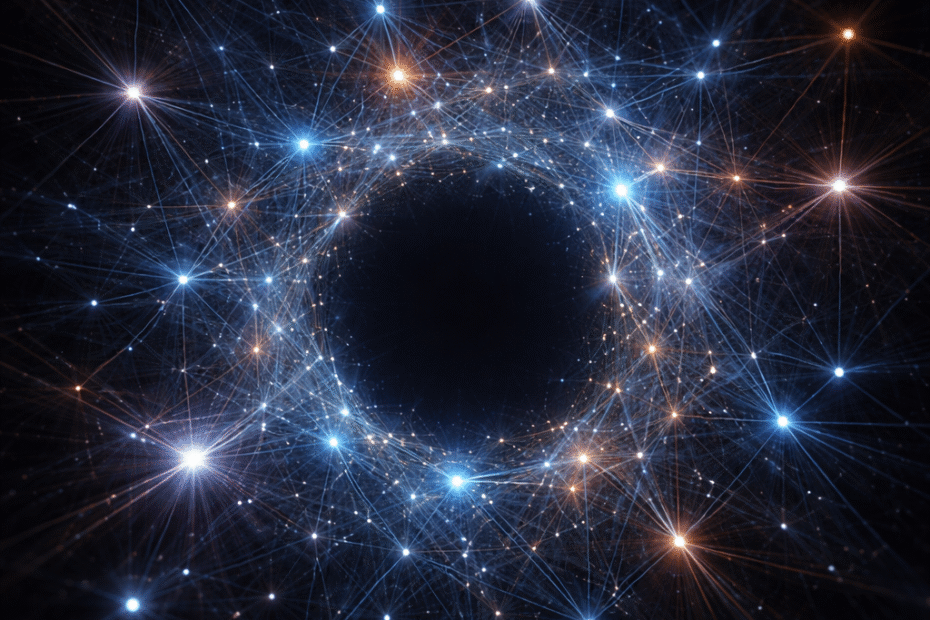
Instead, what we see is distributed organization: local interactions, temporary stability, constant emergence.
The End of the Central Model
The idea of a single center—whether divine, natural, or technological—has shaped human thought for a long time. It provides reassurance: if there is a center, there is intention; if there is intention, there is meaning.
But removing this assumption changes everything.
There may be no global point of control. No unified intelligence orchestrating the whole. No final perspective from which everything is known or justified.
This is not a collapse of meaning. It is a shift in its architecture.
The Human Need for a Center
The idea of a center is deeply attractive because it reduces uncertainty. It creates the feeling that things ultimately make sense somewhere, even if we do not understand how.
This tendency reflects a structural feature of human cognition: we seek stability in the face of complexity. A world without anchors is difficult to inhabit mentally, so the mind naturally constructs them.
The idea of a central order is therefore not only philosophical, but existential: it helps reduce the weight of uncertainty.
The Psychological Mirror of the Center
The need for a center is also echoed in early human experience.
For many, the figures of the father or mother represent the first stable reference points in an unpredictable world. This does not imply that cosmic or metaphysical beliefs are simply “caused” by childhood experience. Rather, it suggests a structural analogy: the mind tends to organize uncertainty by projecting patterns of authority, protection, and orientation onto larger and larger scales.
In this sense, the search for a “Father” or “Mother” of reality may reflect a deeper cognitive tendency to stabilize the unknown through imagined centers of coherence.
Recognizing this does not invalidate philosophical or scientific inquiry. It simply reveals that our models of reality are never purely abstract—they are shaped by the architecture of human experience.
Meaning as a Local Phenomenon
Without a central authority, meaning does not disappear—it becomes local.
It emerges in specific configurations:
- in individual consciousness
- in relationships and cultures
- in biological and historical continuities
- in evolving systems that extend beyond a single lifetime
Meaning is not located “above” reality. It arises within it, temporarily and partially, wherever structures become complex enough to reflect themselves.
In this sense, meaning is not given. It is produced.
The Risk of Fixed Frameworks
When a model becomes too rigid, it tends to repeat itself. It explains the world in the same way, regardless of new experience. It stops generating novelty and begins to reproduce its own assumptions.
At that point, the framework no longer expands understanding—it constrains it.
The challenge is not to abandon all frameworks, but to recognize when they become self-reinforcing loops rather than living tools of interpretation.
Global Systems Without a Center
Contemporary human civilization introduces a new scale of complexity. Global networks, economic systems, and digital infrastructures now operate across billions of interactions in real time, without a single guiding center.
Artificial intelligence extends this dynamic further. Rather than functioning as a unified decision-maker, it emerges as a distributed layer of pattern recognition, shaped by vast amounts of human-generated data and computational processes.
In this context, intelligence does not necessarily imply centralization. On the contrary, the more complex a system becomes, the less it appears to require a single controlling instance.
What emerges instead is a form of coordination without a coordinator: a global system that behaves coherently without being governed from a central point.
This challenges our intuitive expectation that complexity must be directed. It suggests instead that order can arise from interaction rather than intention.
Living Without a Center
To think in a world without a center is not to think without structure. It is to accept that structure is local, temporary, and replaceable.
Coherent models are still necessary, but they are not final. They are tools, not truths. They help us navigate reality, but they do not define it once and for all.
This requires a form of intellectual flexibility: the ability to hold a framework without mistaking it for the framework of reality itself.
Closing Thought
A world without a center does not eliminate meaning. It relocates it.
Meaning becomes something that happens—locally, temporarily, and relationally—rather than something guaranteed by a higher structure.
And perhaps this absence of central control is not a flaw in reality, but the very condition that allows life, complexity, and creativity to exist at all.