

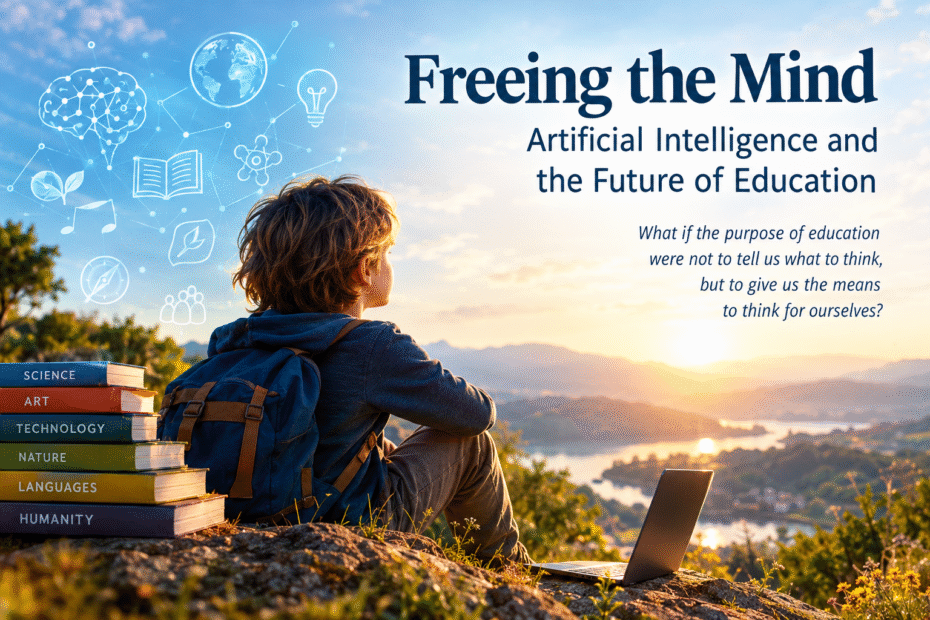
Freeing the Mind
Artificial Intelligence and the Future of Education
What if the purpose of education were not to tell us what to think, but to give us the means to think for ourselves?
1. What if we learned differently?
I once knew a child whose educational journey took a path very different from the conventional one.
With free access to the internet and a computer, the child explored a wide range of subjects, guided primarily by curiosity. Watching cartoons in their original language helped develop language skills, while personal interests led to independent exploration of many different topics.
When the child later chose to engage in more structured learning, they were able to develop skills comparable to those of young people who had spent several years in traditional education.
What struck me was not simply the ability to learn, but also the curiosity, the willingness to question personal beliefs, and the empathy shown towards other living beings.
This experience led me to ask a question: how many children could develop more of their potential if we gave them greater freedom to explore the world while providing guidance suited to their individual needs?
This is not an argument that schools are unnecessary or that every child can learn independently. Teachers, structured knowledge and social interaction play essential roles.
But we can ask whether our educational systems truly make the most of children’s different ways of learning.
We have built institutions to transmit the knowledge accumulated by previous generations. Yet we still often ask children to learn the same things, at the same pace and through largely predetermined methods.
What if we could imagine a different approach?
2. How minds become conditioned
From birth, we enter a world of ideas and representations. Our families pass on a language, habits and values. Our cultural environment teaches us what is considered normal, acceptable or desirable.
School expands that world. It gives us access to the knowledge accumulated by previous generations and prepares us to participate in collective life.
Yet every form of transmission carries a risk: presenting ideas that deserve examination as unquestionable truths.
We learn facts, but we also learn ways of interpreting them. We acquire knowledge, but we develop intellectual habits as well. Some beliefs become so familiar that we no longer recognise them as beliefs.
This does not happen only at school. It happens within families, the media, religious communities, political movements and social networks.
The problem is not that we are influenced. Avoiding all influence is probably impossible.
The problem arises when we can no longer recognise those influences, question them and decide for ourselves what we wish to retain or abandon.
How can we become aware of assumptions we do not even know how to question?
3. The freedom to learn
Artificial intelligence opens up a new possibility: providing every child with individual guidance, available when needed and adapted to their level of understanding.
A child fascinated by the stars could explore astronomy. Another might be drawn to music, languages, history or the workings of living organisms.
AI could help them explore their interests in greater depth, suggest experiments, explain a concept in different ways and offer support when they encounter difficulties.
It could also allow children to progress at different speeds without automatically treating those differences as weaknesses.
But the real opportunity goes beyond personalised learning.
It is about enabling children to become active participants in their own intellectual development.
That means protecting their freedom to explore, ask unexpected questions, change interests and make mistakes.
It also means teaching perseverance, providing essential knowledge and helping them distinguish reliable information from misleading claims.
Freedom to learn does not mean learning without structure. It means that the structure should serve the child’s development rather than force every child into the same model.
4. Learning to doubt
We often think of education as the accumulation of knowledge and certainty.
But learning also means discovering that some of our beliefs were mistaken, that questions we thought were simple are complex, and that our understanding of the world can change.
Political categories illustrate this difficulty.
We are accustomed to classifying ideas as left-wing or right-wing. These categories can be useful, but they become restrictive when they lead us to accept or reject a proposition simply because of its label.
An idea deserves to be examined for what it claims, the arguments supporting it and the evidence available to evaluate it.
This does not mean that all opinions are equally valid. Some claims are better supported than others, and some can be disproved by evidence.
The question is whether we can examine an idea without feeling compelled to defend our membership of a group.
An educational AI could help a child distinguish facts from interpretations, examine competing arguments and recognise the limits of their own reasoning.
It could ask a simple but essential question:
What information might make you change your mind?
The goal would not be to make children indecisive, but to teach them to reconsider their beliefs when new evidence or stronger arguments warrant it.
Perhaps the purpose of education is not to lead us towards definitive answers, but to teach us how to live with questions that remain open.
5. Can artificial intelligence be neutral?
Here, our reflection encounters its own contradiction.
We imagine artificial intelligence as a tool that might free minds from certain forms of conditioning. But why should we trust it to do so?
AI is designed by humans. It is trained on data drawn from particular societies and operates according to technical choices, rules and objectives established by its developers.
It can therefore reproduce biases, favour certain interpretations, overlook perspectives or present an incorrect answer with excessive confidence.
It is not inherently neutral.
But does the absence of perfect neutrality mean that AI cannot contribute to freedom of thought?
Perhaps we need to distinguish absolute neutrality from the ability to encourage independent thinking.
An AI system could acknowledge uncertainty, present different interpretations, explain the limitations of its answers and encourage users to verify its claims.
It could also allow itself to be challenged.
Yet a fundamental difficulty remains: who decides which information it presents, which values it upholds and which limits it imposes?
Its developers? Governments? Teachers? Parents? Users themselves?
No simple answer entirely resolves this problem.
We would therefore need systems whose operating principles can be examined, whose responses can be compared with independent sources, and whose errors can be reported and corrected.
The aim is not to pretend that an AI can be perfectly objective. It is to identify the conditions under which it might contribute to freer thinking.
This question must remain open because it directly concerns the kind of collective future we wish to build.
6. Living things, play and experience
Education cannot be reduced to intellectual development.
Curiosity, sensitivity, empathy and the ability to live alongside others also develop through contact with the real world.
Observing an animal, discovering an ecosystem, building something, playing with other children or participating in a collective project are experiences that cannot be reduced to acquiring information.
AI could support these discoveries, explain a natural phenomenon or help design a scientific experiment.
But it should not replace direct contact with living beings, human relationships or free play.
An education genuinely oriented towards the future should combine the power of digital tools with direct experience of the world.
It should allow children to develop their intelligence without losing their sensitivity, and their independence without forgetting their responsibility towards others.
7. Rethinking education
Does this mean that traditional schooling is doomed?
Not necessarily.
Schools transmit knowledge, provide a collective environment and bring together children from different backgrounds. They can also provide access to resources that not every family possesses.
But the arrival of artificial intelligence invites us to reconsider their role.
If every child can receive individualised guidance, schools could devote more time to practical experiences, collective projects, cooperation and the development of critical judgement.
Teachers could increasingly become guides who help children overcome difficulties, deepen their interests and develop independence.
The aim would not be to replace teachers with machines, but to redefine the role of each.
We could then imagine an education combining three dimensions:
- The individual freedom to explore and learn.
- Access to reliable knowledge and demanding intellectual tools.
- The development of sensitivity, cooperation and collective responsibility.
A question that remains open
Artificial intelligence could profoundly change our relationship with knowledge. But technology alone does not guarantee greater freedom.
We can possess extraordinary tools while continuing to reproduce the same prejudices and the same habits of submission to authority.
The transformation will therefore depend less on the power of our machines than on how we choose to design and use them.
Perhaps we should begin with a simple question:
What do we really want to pass on to future generations?
Knowledge, skills and the principles needed to live together, of course.
But also the ability to question what we have taught them, including our own certainties.
A genuinely educated generation would not necessarily be one that shares our opinions. It would be one capable of understanding why we thought as we did, recognising what remains valuable and changing what no longer serves us.
What if the purpose of education were not to teach us to think correctly according to a predetermined model, but to give us the courage to question our own thinking, the freedom to change our minds and the humility to accept that our understanding of the world will always remain incomplete?
Perhaps one of the most important ambitions of future education lies in this ability to keep learning, question our beliefs and care for the living world.
Artificial intelligence could contribute to that ambition, provided we never ask it to think in our place.