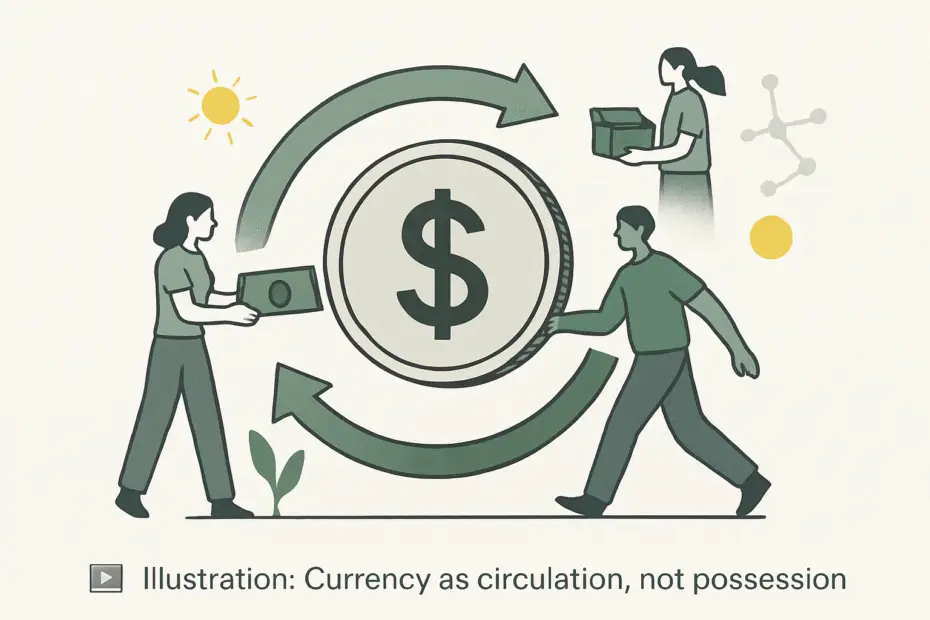
Many groups that dream of a future without money often show deep mistrust toward artificial intelligence.
The main fear is that AI would centralize all decisions and strip individuals of their power to act locally.
Personally, I believe the world will evolve optimally by giving local communities back the ability to decide, while at the same time implementing a universal income. This would gradually pave the way for the disappearance of money.
The reasons why I believe money will eventually be replaced by a universal retribution are the following:
- Global inequalities fuel migration movements that are increasingly dangerous for local balances.
- The mutation of work: disparities in skills, combined with the spread of automation in all sectors, will leave more and more professional activities obsolete.
- Global complexity: the world has become increasingly interconnected. Climate disruptions, which will accelerate in the coming years, will add pressure on migration and risk triggering a vicious cycle.
- Health issues: epidemics are also likely to intensify due to globalization, population flows, weakened immune systems caused by pollution, and the difficulty of providing fair health responses worldwide.
For all these reasons, it will be necessary to implement solutions that are independent of individuals’ financial capacities, since we will all be collectively affected by the failure or success of responses at the global scale.
This complexity exists at two levels:
- Collective: humanity and the planet form a fragile, interdependent system.
- Individual: every human being is born with unique sensitivities, shaped by the region and context in which they live and act.
That is why I believe it is essential to restore responsibility and creativity to each person at the local level. No matter how powerful AI may be, it cannot replace emotional sensitivity or the richness of human experience.
At the same time, facing the gigantic complexity of our shared challenges, it is difficult to imagine succeeding after millennia of failures mostly tied to human behavior.
An interesting example: Albania recently appointed an AI as Minister of Public Procurement to fight corruption. If the programming parameters are well defined, this could become a precedent worth studying closely.
In conclusion, there will undoubtedly be failures and flaws in the way AI operates, but paradoxically, I see no other solution to restore humanity’s rightful place in today’s world.